Zion was a month shy of two (and completely non-verbal) when he started early intervention, and he did not want to go.
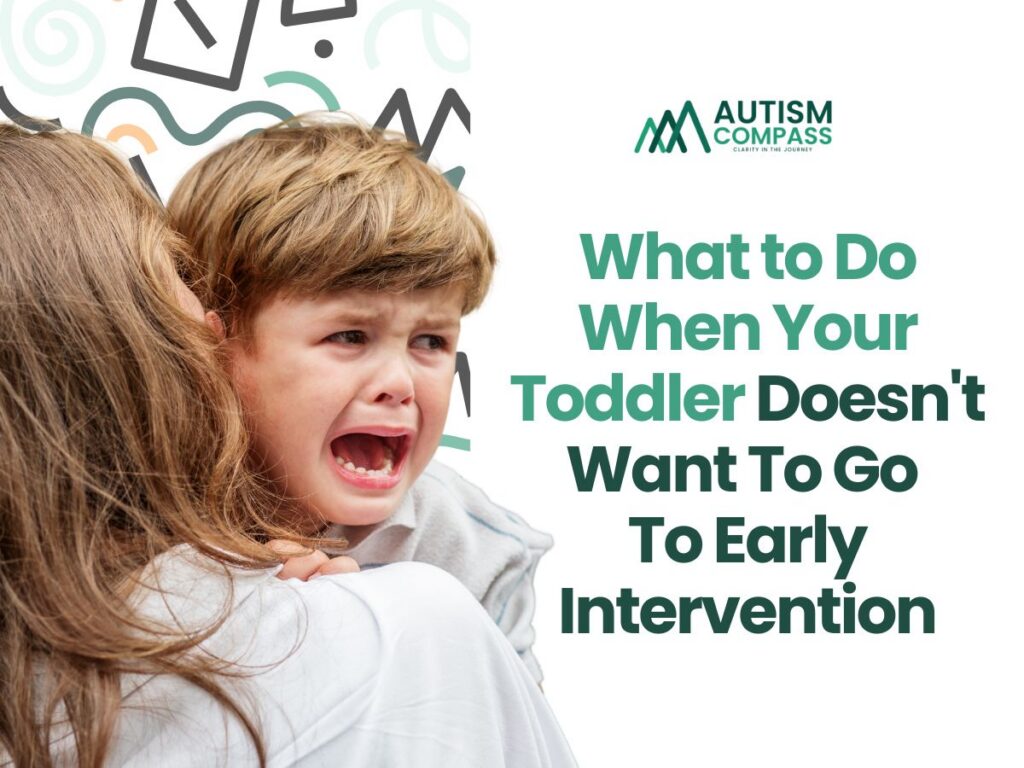
Drop-off was awful. He would cry while we walked away, looking at us with huge tears streaming down his face. And no, he wasn’t fine as soon as we left.
Once we were gone, he wanted his teacher to hold him, and if she tried to put him down, he would scream.
There is something particularly difficult about leaving a child who cannot fully tell you what they’re feeling. You can’t explain that you’ll be back in a way you know they understand. They can’t come home afterward and tell you exactly what happened, who comforted them, what scared them, or whether they eventually felt okay.
We could have decided that his reaction meant he wasn’t ready and stopped sending him.
We didn’t.
But we also didn’t decide that he simply had to get used to it.
What made us comfortable continuing was that we trusted where we were leaving him. We felt confident that he was safe, his teacher was responsive to what he needed, and nobody was expecting him to stop being upset on an adult’s timeline.
In fact, when Zion needed his teacher to carry him, she carried him. Isn’t that incredible?
For us, that distinction became incredibly important. There was a difference between Zion being unsafe and Zion having a very hard time adjusting to something new. We believed we were dealing with the second one, so instead of giving up on early intervention, we changed what we were asking him to manage.
Worrying about an older child not wanting to attend school? Read about school refusal, and what you can do to help.
We Made Early Intervention Smaller Until He Could Handle It
After a few weeks, it was clear that Zion wasn’t adjusting to the schedule as quickly as we had hoped.
So we reduced his time at early intervention to just one hour.
We kept it there for a few weeks and gave him time to get comfortable. Once he was managing that hour better, we added 15 minutes. After another few weeks, we added a little more.
There was no rush to get him to the full schedule.
And slowly, things started to change.
He began playing. He started engaging with the people around him. His teacher could put him down without him immediately becoming distressed. The environment that had initially felt so overwhelming began to become familiar.
By Christmas, he was fine.
More importantly, he was happy!
Two full years later, he is starting his third year of early intervention. There are no huge tears at the door anymore. He doesn’t cling to us or need someone to carry him through the morning. He runs off to play with his friends and teachers, completely confident that he belongs there.
We’ve seen him completely flourish in his early intervention school environment.
I’m incredibly glad we didn’t give up during those first difficult weeks. I’m equally glad we didn’t decide that the only way forward was to keep sending him for longer than he could handle.
We kept the opportunity and changed the expectation.
Is It Normal for a Toddler to Cry at Early Intervention?
A toddler crying at drop-off doesn’t automatically mean something is wrong with the program. Separation from a parent can be hard, especially when a child is very young, has limited communication, struggles with transitions, or needs more time to become comfortable with unfamiliar people and places.
At the same time, I don’t think we should dismiss persistent distress with, “They’ll get over it.”
If your child is struggling with early intervention, daycare, preschool, or another program, it can help to look at the bigger picture rather than judging the situation entirely by what happens during those few minutes at the door.
Are they beginning to settle after you leave? Are there moments when they play, engage, eat, explore, or connect with the adults caring for them? Is their comfort gradually increasing? How do they respond when you arrive for pickup? What are staff telling you about the rest of their time there?
Most importantly, how confident are you in the people caring for your child?
For us, that last question mattered enormously.
Before I Could Push Him, I Had to Know He Was Safe
I think there are times when our kids need a gentle push.
They may need us to help them tolerate separation, try something unfamiliar, build a relationship with a new adult, or stay somewhere without us. If we remove every difficult experience the moment they become upset, we may also remove opportunities for them to discover that they can eventually manage those experiences.
But I could only feel comfortable pushing Zion a little because I trusted the environment we were leaving him in.
That becomes even more important when a child cannot reliably tell you what happens after you walk out the door.
You don’t necessarily have to feel completely comfortable leaving your toddler. That part can be hard regardless of how wonderful the program is. But I do think you should feel confident in the people you’re leaving your child with.
Some of the things I would want to know include:
- Who is directly responsible for my child?
- How do they respond when my child becomes upset?
- Will my child be comforted when they need comfort?
- How will they communicate with me about difficult days?
- How do they support children who are non-speaking or minimally speaking?
- What happens if my child cannot tolerate the planned schedule?
- How are injuries or incidents communicated to parents?
- What methods are used when a child refuses an activity?
- How do they handle physical prompting, and under what circumstances would restraint ever be used?
- Can they tell me what my child actually did during the day, rather than simply saying the day was “good”?
A good program should be able to have these conversations with you.
In Zion’s case, his teacher didn’t just tell us that he was safe with her. Her actions gave us confidence. She responded to what he needed, even when what he needed was to be carried around by her for what must have felt like half the morning.
That mattered to us.
When Your Child Can’t Tell You What Happened
When children can’t reliably tell us about their day, we have to pay closer attention to other forms of communication.
That doesn’t mean assuming every behavioural change is evidence that something bad happened. Toddlers change. Sleep changes. Development happens in bursts. Illness, teething, hunger, transitions, and a dozen other things can affect behaviour.
What can be useful is watching for patterns.
You may notice changes in:
- Sleep
- Eating
- Toileting
- Mood
- Aggression or self-injury
- Communication
- General regulation
- Behaviour when approaching the building
- Reactions to particular people
- Behaviour immediately after pickup
If something feels significantly different, ask questions. If the answers don’t make sense, keep asking.
And if you have genuine concerns about your child’s safety, I don’t think the potential benefits of early intervention outweigh those concerns. There are other programs, other therapists, and other ways to support development.
Early intervention should support your child. It should never require you to ignore serious concerns about their well-being.
When Is It Okay to Push a Little?
This was probably the hardest part for me to figure out.
There is a lot of conversation in parenting about listening to our kids, and I absolutely believe we should. I also believe that listening doesn’t always mean removing the thing they’re struggling with.
Sometimes our children are telling us, “I can’t do this.”
Our job may be to determine whether that means “I cannot do this safely” or “I cannot do this yet in the way you’re asking me to.”
With Zion, we felt confident it was the latter.
He was safe. His teacher was responsive. We could see that he was gradually beginning to connect with her. The problem wasn’t that we believed early intervention was hurting him. The problem was that the length of time we were asking him to stay was more than his nervous system could manage at that point.
So we pushed a little, but we also listened.
Instead of expecting him to suddenly manage the full program, we found the amount he could manage and started there.
That is very different from repeatedly leaving a child in significant distress and assuming they will eventually get used to it.
You Can Adjust the Plan Without Giving Up on the Goal
A full session isn’t the only way for early intervention to be worthwhile.
Depending on the program and your child’s needs, there may be several ways to make the transition easier:
- Shorten sessions temporarily.
- Increase attendance in small increments.
- Use the same drop-off routine each day.
- Have a familiar staff member meet your child when they arrive.
- Allow a comfort item when appropriate.
- Use a visual schedule to make the day more predictable.
- Begin with an activity your child enjoys.
- Arrive during a quieter part of the morning when possible.
- Give your child time at one schedule before increasing it again.
Our approach happened to be increasing Zion’s time by about 15 minutes every few weeks. That isn’t a formula I would expect another family to follow. It was simply the pace that worked for him.
There is also good reason not to assume that more hours automatically mean better results. A 2024 meta-analysis of 144 studies involving more than 9,000 autistic children found no significant association between the amount of intervention children received and the size of the intervention effects. The researchers specifically cautioned against assuming that intensifying intervention necessarily produces greater developmental benefits.
That research really reinforces something I wish more parents heard: the goal isn’t to accumulate as many therapy hours as possible.
The goal is to find appropriate support that your child can meaningfully participate in.
What If Your Child Isn’t Adjusting?
Zion’s story had a happy progression. He struggled, we reduced his hours, he gradually adjusted, and eventually he loved going.
Not every child will follow that pattern.
If your child remains intensely distressed, their distress is increasing, or weeks are passing without any signs that they are becoming more comfortable, I would look at the situation again rather than assuming they simply need more time.
It can help to ask:
- Is the length of the program still too much?
- Is there a particular part of the day that seems to be causing the problem?
- Is the sensory environment overwhelming?
- Has my child formed a connection with any of the adults there?
- Is the intervention approach a good fit for my child?
- Is my child spending most of the session regulated enough to participate?
- Are staff willing and able to adapt?
- Are we seeing any signs of increasing comfort?
- Do I still feel confident that my child is safe?
Sometimes the answer will be to keep going more slowly. Sometimes a different schedule, provider, therapist, or program may be a better fit.
Changing course doesn’t mean early intervention failed, and it certainly doesn’t mean your child failed.
What Does “Early Intervention” Actually Mean?
Early intervention isn’t one specific autism therapy.
Depending on your child and where you live, early supports may involve speech-language therapy, occupational therapy, developmental or play-based programs, behavioural support, parent or caregiver training, educational programming, or a combination of services. The Government of Canada similarly describes autism supports as potentially including occupational therapy, speech and language therapy, behavioural therapy, parent and caregiver training, and education planning.
The right combination will depend on the child.
That matters because parents sometimes hear “early intervention is important” and understandably interpret that as pressure to enrol their toddler in a particular therapy, for a particular number of hours, as quickly as possible.
The research is more nuanced than that.
There is evidence that early interventions can support development in some areas. A large updated systematic review of 252 studies found evidence of benefits for certain intervention types and outcomes, particularly social communication, although the strength of the evidence changed when researchers accounted for study design and risk of bias. Other meta-analyses have found improvements in areas such as social communication, daily living skills, motor skills, and spoken language, depending on the intervention and the outcomes being measured.
In other words, I think early intervention can be an incredibly valuable opportunity, and it certainly has been for our family. But I wouldn’t reduce that idea to “more therapy earlier is always better.”
Our kids are individuals. The support has to work for the child receiving it.
How to Find Early Intervention for an Autistic Child
Finding early intervention can be confusing because there isn’t one universal program called “early intervention,” and in Canada, the services available depend heavily on your province or territory.
A good starting point is often your child’s family doctor, pediatrician, developmental team, or local health authority. You can ask specifically about services available for young children with developmental delays or autism, including speech-language pathology, occupational therapy, early childhood development programs, and autism-specific services.
The Government of Canada also maintains an overview of autism supports and explains that families may find services through government and community programs.
Government of Canada: Autism Supports and Services
If you’re searching on your own, I would look in a few places:
- Your provincial or territorial autism program
- Your regional or provincial health authority
- Public early childhood intervention or developmental services
- Local speech-language pathology and occupational therapy programs
- Autism organizations in your province
- Children’s hospitals or child development centres
- Community agencies serving children with developmental disabilities
You can also ask other parents what programs they have used, but I would treat recommendations as a starting point rather than proof that a program will be right for your child.
A program that was wonderful for someone else’s child may not be the right environment for yours.
Questions to Ask an Early Intervention Program
Once you find a program, the next challenge is figuring out whether you actually want to leave your child there.
Before enrolling, I would want to understand both what they do and how they treat children while doing it.
Some questions worth asking include:
- What does a typical day or session look like?
- Who will work directly with my child?
- What training and qualifications do staff have?
- How are goals chosen?
- How much input do parents have?
- How do you support AAC and other forms of communication?
- What happens if my child refuses an activity?
- What happens when a child cries or becomes dysregulated?
- Can sessions be shortened or adjusted if my child is struggling?
- How do you measure progress?
- How often will we discuss my child’s progress and goals?
- Can parents observe the program?
- How are injuries, incidents, or safety concerns reported?
- What is your policy on physical prompting, restraint, and seclusion?
I would also pay attention to how you feel while those questions are being answered. You don’t need a program to tell you everything you want to hear, but you should feel that your questions are welcome and that your child is being treated as a person rather than a collection of skills that need to be fixed.
Two Years Later, He Runs In
Sometimes I think back to that tiny boy who needed his teacher to carry him because being put down felt like too much.
If we had stopped early intervention during those first few weeks, I would have understood why. Walking away from your sobbing toddler is horrible.
But we knew something important that Zion couldn’t tell us himself yet: he was safe.
We trusted his teacher because we could see that she was listening to him, even when his communication looked like crying, clinging, and refusing to be put down. We believed the program could benefit him, but we also recognized that he needed more time to become comfortable there.
So we gave him that time.
We didn’t ignore his distress, and we didn’t let his distress make every decision for him. We adjusted what we were asking of him until he was ready for more.
Now, two years later, I watch him walk into the same kind of environment without hesitation. He knows his teachers. He has friends. He plays, participates, learns, and confidently moves through a world that once felt enormous without needing us beside him.
That is part of what I hope early intervention can give our kids.
Not simply more words, better fine motor skills, or another goal checked off a therapy plan, although those things can matter too. I want our kids to build confidence, develop relationships, learn how to communicate what they need, discover what they can do, and gradually feel safe in a world that asks them to do an awful lot of unfamiliar things.
Sometimes getting there means pushing a little. Sometimes it means slowing way down.
The important part, at least for our family, was knowing the difference.